> ## Documentation Index
> Fetch the complete documentation index at: https://forest-chore-open-api.mintlify.site/llms.txt
> Use this file to discover all available pages before exploring further.
# Create a Smart relationship
### What is a Smart Relationship?
Sometimes, you want to create a virtual relationship between two set of data that does not exist in your database. A concrete example could be creating a relationship between two collections available in two different databases. Creating a Smart Relationship allows you to customize with code how your collections are linked together.
### Create a BelongsTo Smart Relationship
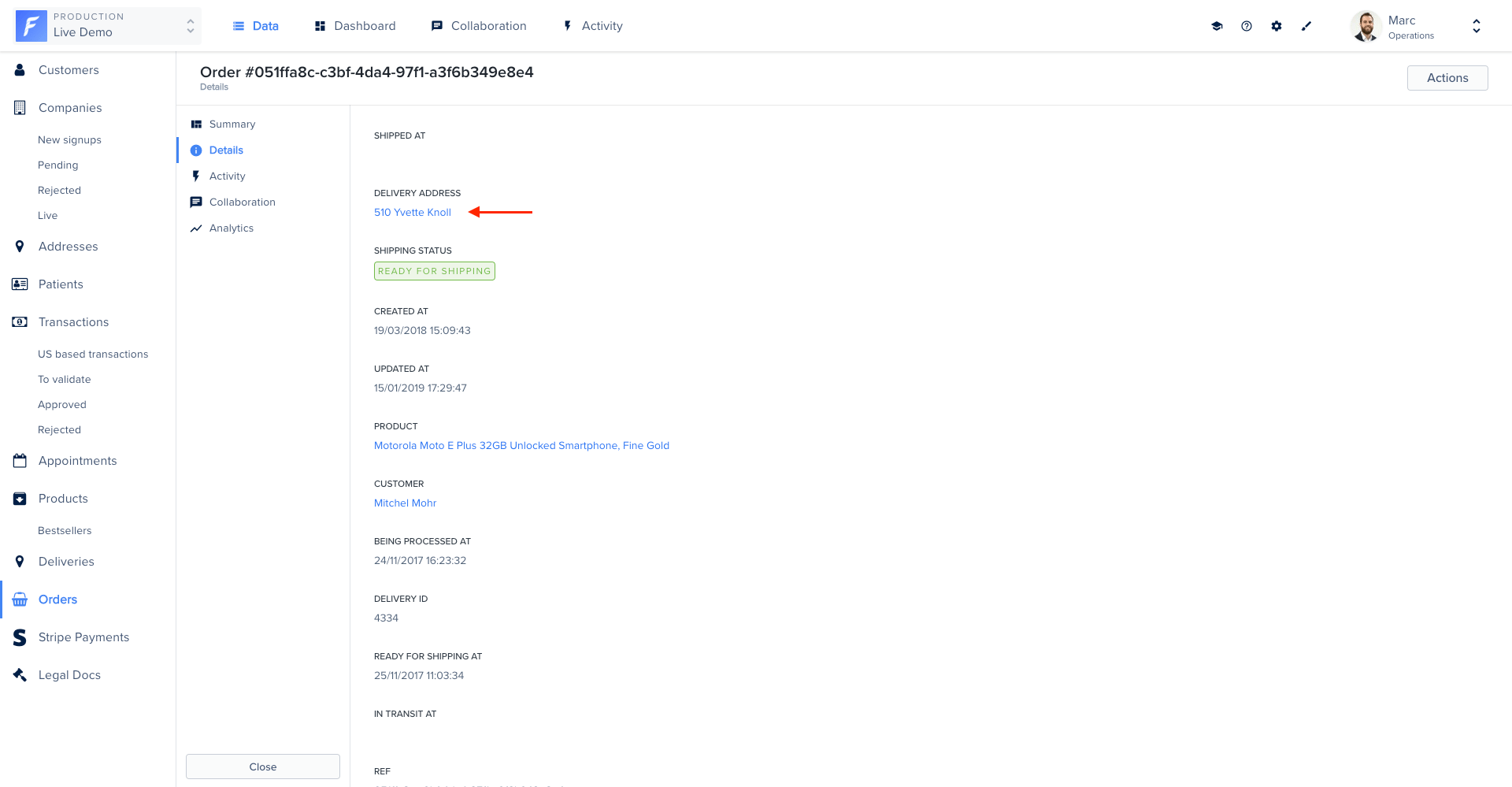
On the Live Demo example, we have an **order** which `belongsTo` a **customer** which `belongsTo` a **delivery address**. We’ve created here a BelongsTo Smart Relationship that acts like a shortcut between the **order** and the **delivery address**.
A BelongsTo Smart Relationship is created like a [Smart Field](/legacy/ruby-agent/reference-guide/smart-fields/overview#what-is-a-smart-field) with the `reference` option to indicate on which collection the Smart Relationship points to. You will also need to code the logic of the search query.
```ruby theme={null}
class Forest::Order
include ForestLiana::Collection
collection :Order
search_delivery_address = lambda do |query, search|
query.joins(customer: :address).or(Order.joins(customer: :address).where("addresses.country ILIKE ?", "%#{search}%"))
end
belongs_to :delivery_address, reference: 'Address.id', search: search_delivery_address do
object.customer.address
end
end
```
Ensure the file app/forest/\_\_init\_\_.py exists and contains the import of the previous defined class :
 ### Create a HasMany Smart Relationship
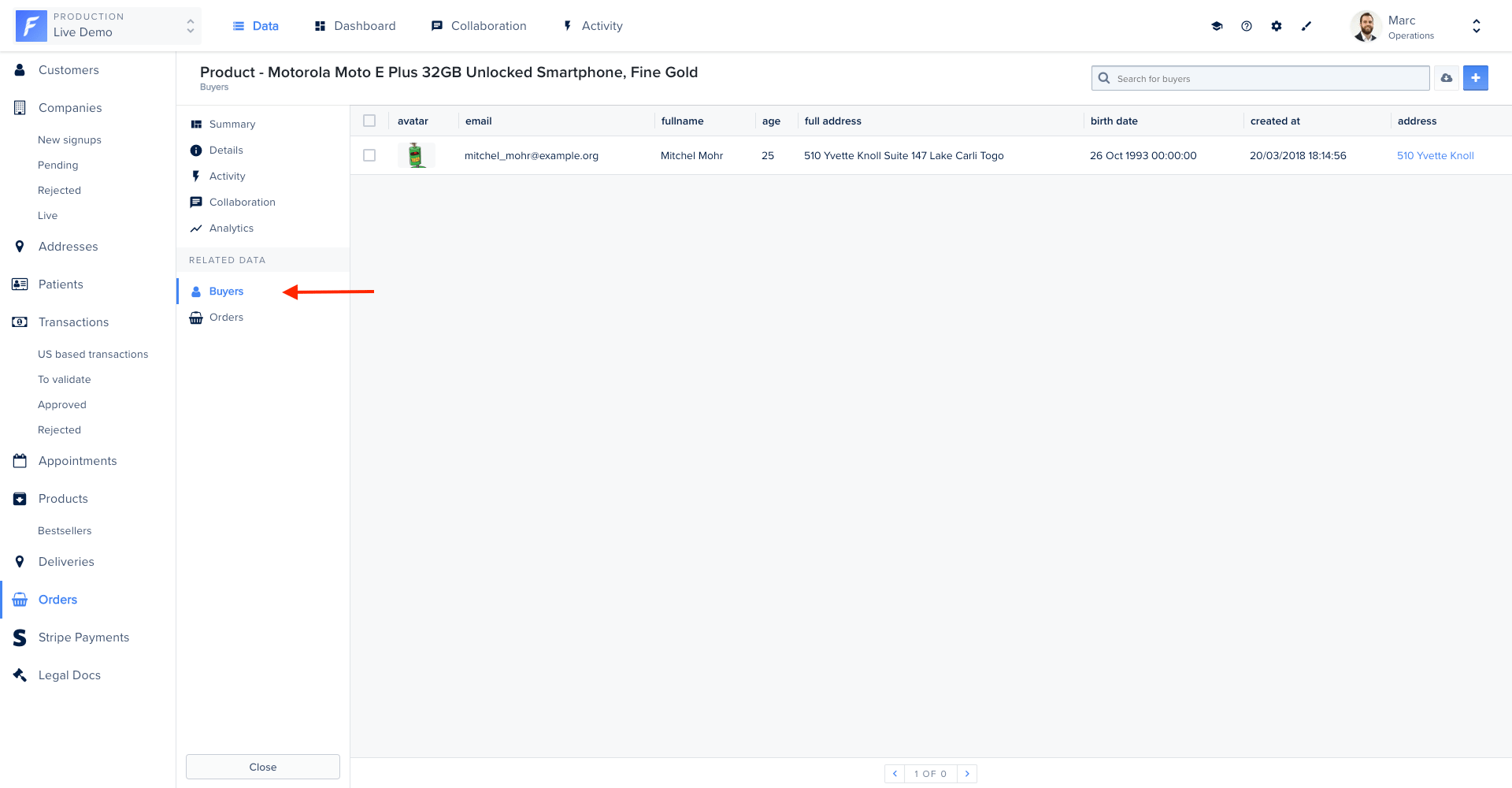
On the Live Demo example, we have a **product** `hasMany` **orders** and an **order** `belongsTo` **customer**. We’ve created a Smart Relationship that acts like a shortcut: **product** `hasMany` **customers**.
A HasMany Smart Relationship is created like a [Smart Field](https://docs.forestadmin.com/documentation/reference-guide/fields/create-and-manage-smart-fields) with the `reference` option to indicates on which collection the Smart Relationship points to.
```ruby theme={null}
class Forest::Product
include ForestLiana::Collection
collection :Product
has_many :buyers, type: ['String'], reference: 'Customer.id'
end
```
Upon browsing, an API call is triggered when accessing the data of the HasMany relationships in order to fetch them asynchronously. In the following example, the API call is a GET on `/Product/:product_id/buyers`.
We’ve built the right SQL query using [Active Record](http://guides.rubyonrails.org/active_record_basics.html) to **count** and **find all** customers who bought the current product.
Then, you should handle pagination in order to avoid performance issue. The API call has a querystring available which gives you all the necessary parameters you need to enable pagination.
Finally, you don’t have to serialize the data yourself. The Forest agent already knows how to serialize your collection (`Customer` in this example). You can access to the serializer through the `serialize_models()` function.
```ruby theme={null}
Rails.application.routes.draw do
# MUST be declared before the mount ForestLiana::Engine.
namespace :forest do
get '/Product/:product_id/buyers' => 'orders#buyers'
end
mount ForestLiana::Engine => '/forest'
end
```
```ruby theme={null}
class Forest::ProductsController < ForestLiana::ApplicationController
def buyers
limit = params['page']['size'].to_i
offset = (params['page']['number'].to_i - 1) * limit
product = Product.find(params['product_id'])
customers = Customer.where(order_id: product.orders.ids)
render json: serialize_models(customers.limit(limit).offset(offset), meta: {count: customers.count})
end
end
```
Upon browsing, an API call is triggered when accessing the data of the HasMany relationships in order to fetch them asynchronously. In the following example, the API call is a GET on `/app_product/:product_pk/relationships/buyers`.\
\
You will have to declare this route in your app **urls.py** file
Then create the pertained view
We’ve built the right SQL query using [Django ORM](https://docs.djangoproject.com/en/3.2/topics/db/queries/) to **find all** customers who bought the current product.
Then, you should handle pagination in order to avoid performance issue. The API call has a querystring available which gives you all the necessary parameters you need to enable pagination.
Finally, you don’t have to serialize the data yourself. The Forest agent already knows how to serialize your collection (`Customer` in this example, with the table name `app_customer`). You can access to the serializer through the `Schema().dump` function (using [marshmallow-jsonapi](https://marshmallow-jsonapi.readthedocs.io/en/latest/) internally).
Upon browsing, an API call is triggered when accessing the data of the HasMany relationships in order to fetch them asynchronously. In the following example, the API call is a GET on `/product/{id}/relationships/buyers`.
We’ve built the right SQL query using [Active Record](http://guides.rubyonrails.org/active_record_basics.html) to **count** and **find all** customers who bought the current product.
Then, you should handle pagination in order to avoid performance issue. The API call has a querystring available which gives you all the necessary parameters you need to enable pagination.
Finally, you don’t have to serialize the data yourself. The Forest agent already knows how to serialize your collection (`Customer` in this example). You can access to the serializer through the `render()` function of JsonApi facade.
### Create a HasMany Smart Relationship
On the Live Demo example, we have a **product** `hasMany` **orders** and an **order** `belongsTo` **customer**. We’ve created a Smart Relationship that acts like a shortcut: **product** `hasMany` **customers**.
A HasMany Smart Relationship is created like a [Smart Field](https://docs.forestadmin.com/documentation/reference-guide/fields/create-and-manage-smart-fields) with the `reference` option to indicates on which collection the Smart Relationship points to.
```ruby theme={null}
class Forest::Product
include ForestLiana::Collection
collection :Product
has_many :buyers, type: ['String'], reference: 'Customer.id'
end
```
Upon browsing, an API call is triggered when accessing the data of the HasMany relationships in order to fetch them asynchronously. In the following example, the API call is a GET on `/Product/:product_id/buyers`.
We’ve built the right SQL query using [Active Record](http://guides.rubyonrails.org/active_record_basics.html) to **count** and **find all** customers who bought the current product.
Then, you should handle pagination in order to avoid performance issue. The API call has a querystring available which gives you all the necessary parameters you need to enable pagination.
Finally, you don’t have to serialize the data yourself. The Forest agent already knows how to serialize your collection (`Customer` in this example). You can access to the serializer through the `serialize_models()` function.
```ruby theme={null}
Rails.application.routes.draw do
# MUST be declared before the mount ForestLiana::Engine.
namespace :forest do
get '/Product/:product_id/buyers' => 'orders#buyers'
end
mount ForestLiana::Engine => '/forest'
end
```
```ruby theme={null}
class Forest::ProductsController < ForestLiana::ApplicationController
def buyers
limit = params['page']['size'].to_i
offset = (params['page']['number'].to_i - 1) * limit
product = Product.find(params['product_id'])
customers = Customer.where(order_id: product.orders.ids)
render json: serialize_models(customers.limit(limit).offset(offset), meta: {count: customers.count})
end
end
```
Upon browsing, an API call is triggered when accessing the data of the HasMany relationships in order to fetch them asynchronously. In the following example, the API call is a GET on `/app_product/:product_pk/relationships/buyers`.\
\
You will have to declare this route in your app **urls.py** file
Then create the pertained view
We’ve built the right SQL query using [Django ORM](https://docs.djangoproject.com/en/3.2/topics/db/queries/) to **find all** customers who bought the current product.
Then, you should handle pagination in order to avoid performance issue. The API call has a querystring available which gives you all the necessary parameters you need to enable pagination.
Finally, you don’t have to serialize the data yourself. The Forest agent already knows how to serialize your collection (`Customer` in this example, with the table name `app_customer`). You can access to the serializer through the `Schema().dump` function (using [marshmallow-jsonapi](https://marshmallow-jsonapi.readthedocs.io/en/latest/) internally).
Upon browsing, an API call is triggered when accessing the data of the HasMany relationships in order to fetch them asynchronously. In the following example, the API call is a GET on `/product/{id}/relationships/buyers`.
We’ve built the right SQL query using [Active Record](http://guides.rubyonrails.org/active_record_basics.html) to **count** and **find all** customers who bought the current product.
Then, you should handle pagination in order to avoid performance issue. The API call has a querystring available which gives you all the necessary parameters you need to enable pagination.
Finally, you don’t have to serialize the data yourself. The Forest agent already knows how to serialize your collection (`Customer` in this example). You can access to the serializer through the `render()` function of JsonApi facade.