> ## Documentation Index
> Fetch the complete documentation index at: https://forest-chore-open-api.mintlify.site/llms.txt
> Use this file to discover all available pages before exploring further.
# Use a Smart Action Form
We've just introduced Smart actions: they're great because you can execute virtually any business logic. However, there is one big part missing: how do you let your users provide more information or have interaction when they trigger the Smart action? In short, you need to open a **Smart Action Form**.
## Opening a **Smart Action Form**
Very often, you will need to ask user inputs before triggering the logic behind a Smart Action.\
For example, you might want to specify a reason if you want to block a user account. Or set the amount to charge a user’s credit card.
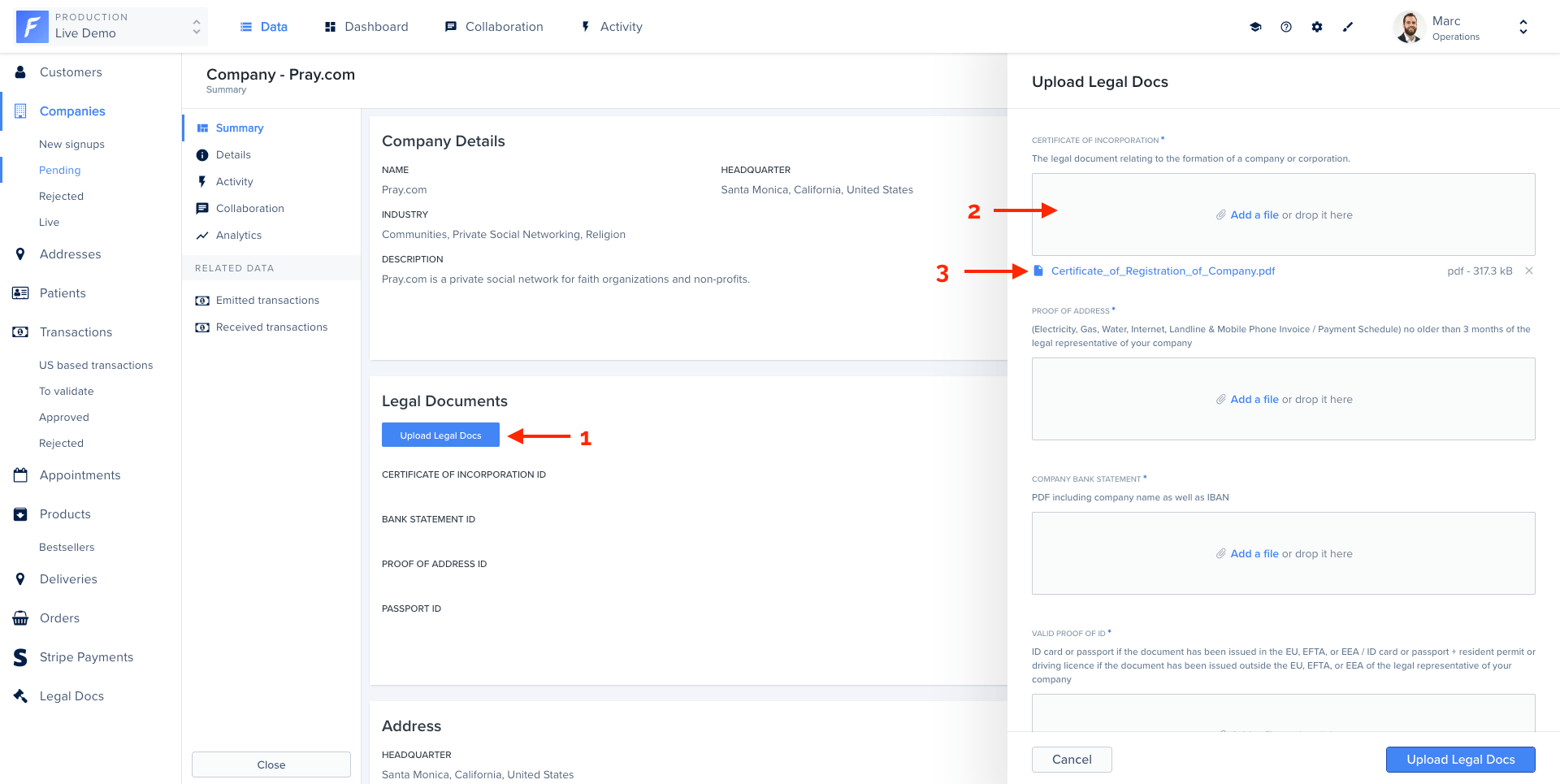
On our Live Demo example, we’ve defined 4 input fields on the Smart Action `Upload Legal Docs` on the collection `companies`.
```javascript theme={null}
const { collection } = require('forest-express-sequelize');
collection('companies', {
actions: [
{
name: 'Upload Legal Docs',
type: 'single',
fields: [
{
field: 'Certificate of Incorporation',
description:
'The legal document relating to the formation of a company or corporation.',
type: 'File',
isRequired: true,
},
{
field: 'Proof of address',
description:
'(Electricity, Gas, Water, Internet, Landline & Mobile Phone Invoice / Payment Schedule) no older than 3 months of the legal representative of your company',
type: 'File',
isRequired: true,
},
{
field: 'Company bank statement',
description: 'PDF including company name as well as IBAN',
type: 'File',
isRequired: true,
},
{
field: 'Valid proof of ID',
description:
'ID card or passport if the document has been issued in the EU, EFTA, or EEA / ID card or passport + resident permit or driving license if the document has been issued outside the EU, EFTA, or EEA of the legal representative of your company',
type: 'File',
isRequired: true,
},
],
},
],
});
```
```javascript theme={null}
const { PermissionMiddlewareCreator } = require('forest-express-sequelize');
const permissionMiddlewareCreator = new PermissionMiddlewareCreator('companies');
...
router.post('/actions/upload-legal-docs', permissionMiddlewareCreator.smartAction(),
(req, res) => {
// Get the current company id
let companyId = req.body.data.attributes.ids[0];
// Get the values of the input fields entered by the admin user.
let attrs = req.body.data.attributes.values;
let certificate_of_incorporation = attrs['Certificate of Incorporation'];
let proof_of_address = attrs['Proof of address'];
let company_bank_statement = attrs['Company bank statement'];
let passport_id = attrs['Valid proof of id'];
// The business logic of the Smart Action. We use the function
// UploadLegalDoc to upload them to our S3 repository. You can see the full
// implementation on our Forest Live Demo repository on Github.
return P.all([
uploadLegalDoc(companyId, certificate_of_incorporation, 'certificate_of_incorporation_id'),
uploadLegalDoc(companyId, proof_of_address, 'proof_of_address_id'),
uploadLegalDoc(companyId, company_bank_statement,'bank_statement_id'),
uploadLegalDoc(companyId, passport_id, 'passport_id'),
])
.then(() => {
// Once the upload is finished, send a success message to the admin user in the UI.
res.send({ success: 'Legal documents are successfully uploaded.' });
});
});
...
module.exports = router;
```
On our Live Demo example, we’ve defined 4 input fields on the Smart Action `Upload Legal Docs` on the collection `companies`.
```javascript theme={null}
const { collection } = require('forest-express-mongoose');
collection('companies', {
actions: [{
name: 'Upload Legal Docs',
type: 'single',
fields: [{
field: 'Certificate of Incorporation',
description: 'The legal document relating to the formation of a company or corporation.',
type: 'File',
isRequired: true
}, {
field: 'Proof of address',
description: '(Electricity, Gas, Water, Internet, Landline & Mobile Phone Invoice / Payment Schedule) no older than 3 months of the legal representative of your company',
type: 'File',
isRequired: true
}, {
field: 'Company bank statement',
description: 'PDF including company name as well as IBAN',
type: 'File',
isRequired: true
}, {
field: 'Valid proof of ID',
description: 'ID card or passport if the document has been issued in the EU, EFTA, or EEA / ID card or passport + resident permit or driving license if the document has been issued outside the EU, EFTA, or EEA of the legal representative of your company',
type: 'File',
isRequired: true
}],
});
```
```javascript theme={null}
...
router.post('/actions/upload-legal-docs',
(req, res) => {
// Get the current company id
let companyId = req.body.data.attributes.ids[0];
// Get the values of the input fields entered by the admin user.
let attrs = req.body.data.attributes.values;
let certificate_of_incorporation = attrs['Certificate of Incorporation'];
let proof_of_address = attrs['Proof of address'];
let company_bank_statement = attrs['Company bank statement'];
let passport_id = attrs['Valid proof of id'];
// The business logic of the Smart Action. We use the function
// UploadLegalDoc to upload them to our S3 repository. You can see the full
// implementation on our Forest Live Demo repository on Github.
return P.all([
uploadLegalDoc(companyId, certificate_of_incorporation, 'certificate_of_incorporation_id'),
uploadLegalDoc(companyId, proof_of_address, 'proof_of_address_id'),
uploadLegalDoc(companyId, company_bank_statement,'bank_statement_id'),
uploadLegalDoc(companyId, passport_id, 'passport_id'),
])
.then(() => {
// Once the upload is finished, send a success message to the admin user in the UI.
res.send({ success: 'Legal documents are successfully uploaded.' });
});
});
...
module.exports = router;
```
On our Live Demo example, we’ve defined 4 input fields on the Smart Action `Upload Legal Docs` on the collection `Company`.
```ruby theme={null}
class Forest::Company
include ForestLiana::Collection
collection :Company
action 'Upload Legal Docs', type: 'single', fields: [{
field: 'Certificate of Incorporation',
description: 'The legal document relating to the formation of a company or corporation.',
type: 'File',
is_required: true
}, {
field: 'Proof of address',
description: '(Electricity, Gas, Water, Internet, Landline & Mobile Phone Invoice / Payment Schedule) no older than 3 months of the legal representative of your company',
type: 'File',
is_required: true
}, {
field: 'Company bank statement',
description: 'PDF including company name as well as IBAN',
type: 'File',
is_required: true
}, {
field: 'Valid proof of ID',
description: 'ID card or passport if the document has been issued in the EU, EFTA, or EEA / ID card or passport + resident permit or driving license if the document has been issued outside the EU, EFTA, or EEA of the legal representative of your company',
type: 'File',
is_required: true
}]
end
```
```ruby theme={null}
Rails.application.routes.draw do
# MUST be declared before the mount ForestLiana::Engine.
namespace :forest do
post '/actions/upload-legal-docs' => 'companies#upload_legal_docs'
end
mount ForestLiana::Engine => '/forest'
end
```
```ruby theme={null}
class Forest::CompaniesController < ForestLiana::SmartActionsController
def upload_legal_doc(company_id, doc, field)
id = SecureRandom.uuid
Forest::S3Helper.new.upload(doc, "livedemo/legal/#{id}")
company = Company.find(company_id)
company[field] = id
company.save
Document.create({
file_id: company[field],
is_verified: true
})
end
def upload_legal_docs
# Get the current company id
company_id = ForestLiana::ResourcesGetter.get_ids_from_request(params, forest_user).first
# Get the values of the input fields entered by the admin user.
attrs = params.dig('data', 'attributes', 'values')
certificate_of_incorporation = attrs['Certificate of Incorporation'];
proof_of_address = attrs['Proof of address'];
company_bank_statement = attrs['Company bank statement'];
passport_id = attrs['Valid proof of ID'];
# The business logic of the Smart Action. We use the function
# upload_legal_doc to upload them to our S3 repository. You can see the
# full implementation on our Forest Live Demo repository on Github.
upload_legal_doc(company_id, certificate_of_incorporation, 'certificate_of_incorporation_id')
upload_legal_doc(company_id, proof_of_address, 'proof_of_address_id')
upload_legal_doc(company_id, company_bank_statement, 'bank_statement_id')
upload_legal_doc(company_id, passport_id, 'passport_id')
# Once the upload is finished, send a success message to the admin user in the UI.
render json: { success: 'Legal documents are successfully uploaded.' }
end
end
```
On our Live Demo example, we’ve defined 4 input fields on the Smart Action `Upload Legal Docs` on the collection `Company`.
Ensure the file app/forest/\_\_init\_\_.py exists and contains the import of the previous defined class :
On our Live Demo example, we’ve defined 4 input fields on the Smart Action `Upload Legal Docs` on the collection `Company`.
The 2nd parameter of the `SmartAction` method is not required. If you don't fill it, the name of your smartAction will be the name of your method that wrap it.
 ### Handling input values
Here is the list of available options to customize your input form.
| Name | Type | Description |
| ----------- | ---------------- | -------------------------------------------------------------------------------------------------------------------------------------------------------------------------------------------------------------------------------------------------------------------------------------------- |
| field | string | Label of the input field. |
| type | string or array |
### Handling input values
Here is the list of available options to customize your input form.
| Name | Type | Description |
| ----------- | ---------------- | -------------------------------------------------------------------------------------------------------------------------------------------------------------------------------------------------------------------------------------------------------------------------------------------- |
| field | string | Label of the input field. |
| type | string or array | Type of your field.
- string:
Boolean, Date, Dateonly, Enum, File, Number, String - array:
\['Enum'], \['Number'], \['String']
|
| reference | string | (optional) Specify that the input is a reference to another collection. You must specify the primary key (ex: `category.id`). |
| enums | array of strings | (optional) Required only for the `Enum` type. This is where you list all the possible values for your input field. |
| description | string | (optional) Add a description for your admin users to help them fill correctly your form |
| isRequired | boolean | (optional) If `true`, your input field will be set as required in the browser. Default is `false`. |
| hook | string | (optional) Specify the change hook. If specified the corresponding hook is called when the input change |
| widget | string | (optional) The following widgets are available to your smart action fields (`text area`, `date`, `boolean`, `file,` `dateonly`) |
The `widget` property is only partially supported.
If you want to use a custom widget via a Smart Action Hook, you'll need to use the syntax mentioned in the next section.
## Use components to better layout your form
This feature is only available from **version 9.4.0** (`forest-express-sequelize` and `forest-express-mongoose`) / **version 9.4.0** (`forest-rails`) .
you must define your layout in a `load` hook at minima, and repeat it in each `change` hook.
This feature is useful when dealing with long/complex forms, with many fields. It will let you organize them and add useful information to guide the end user.
The layout must contain the fields as they should be rendered on the form.
### List of supported layout components
### Node.js
```javascript theme={null}
// Page
{
type: 'Layout',
component: 'Page',
elements: [] // An array of fields or other layout elements (except other pages)
},
// Row
{
type: 'Layout',
component: 'Row',
fields: [] // An array of one or two fields
}
// Separator
{
type: 'Layout',
component: 'Separator',
}
// Html bloc
{
type: 'Layout',
component: 'HtmlBlock',
content: '...' // A text content, which supports html tags
}
```
### Example
Here's an example of an action form with many fields, that we want to improve with some layout components, to make it easier for the end user to fill in.
### Node.js
```javascript theme={null}
const applyLayout = (fields) => {
const fieldByName = (name) => fields.find((field) => field.field === name);
return [
{
type: 'Layout',
component: 'Page',
elements: [
{
type: 'Layout',
component: 'HtmlBlock',
content: 'Please fill in the customer details first, following this guide
'
},
{
type: 'Layout',
component: 'Row',
fields: [fieldByName('firstname'), fieldByName('lastname')]
},
{ type: 'Layout', component: 'Separator' },
fieldByName('username'),
fieldByName('email'),
]
},
{
type: 'Layout',
component: 'Page',
elements: [
{
type: 'Layout',
component: 'HtmlBlock',
content: 'You may now enter his address details'
},
{
type: 'Layout',
component: 'Row',
fields: [fieldByName('city'), fieldByName('zip code')]
},
fieldByName('country'),
]
}
]
}
collection('customers', {
actions: [
{
name: 'Send invoice',
type: 'single',
fields: [
{
field: 'firstname',
type: 'String',
isRequired: true,
},
{
field: 'lastname',
type: 'String',
isRequired: true,
},
{
field: 'username',
type: 'String',
},
{
field: 'email',
type: 'String',
isRequired: true,
},
{
field: 'country',
type: 'Enum',
enums: [],
},
{
field: 'city',
type: 'String',
hook: 'onCityChange',
},
{
field: 'zip code',
type: 'String',
hook: 'onZipCodeChange',
},
],
hooks: {
load: async ({ fields }) => {
return applyLayout(fields);
},
change: {
onCityChange: async ({ fields }) => {
return applyLayout(fields);
},
onZipCodeChange: async ({ fields }) => {
return applyLayout(fields);
},
},
},
},
],
fields: [],
segments: [],
});
```
### Prefill a form with default values
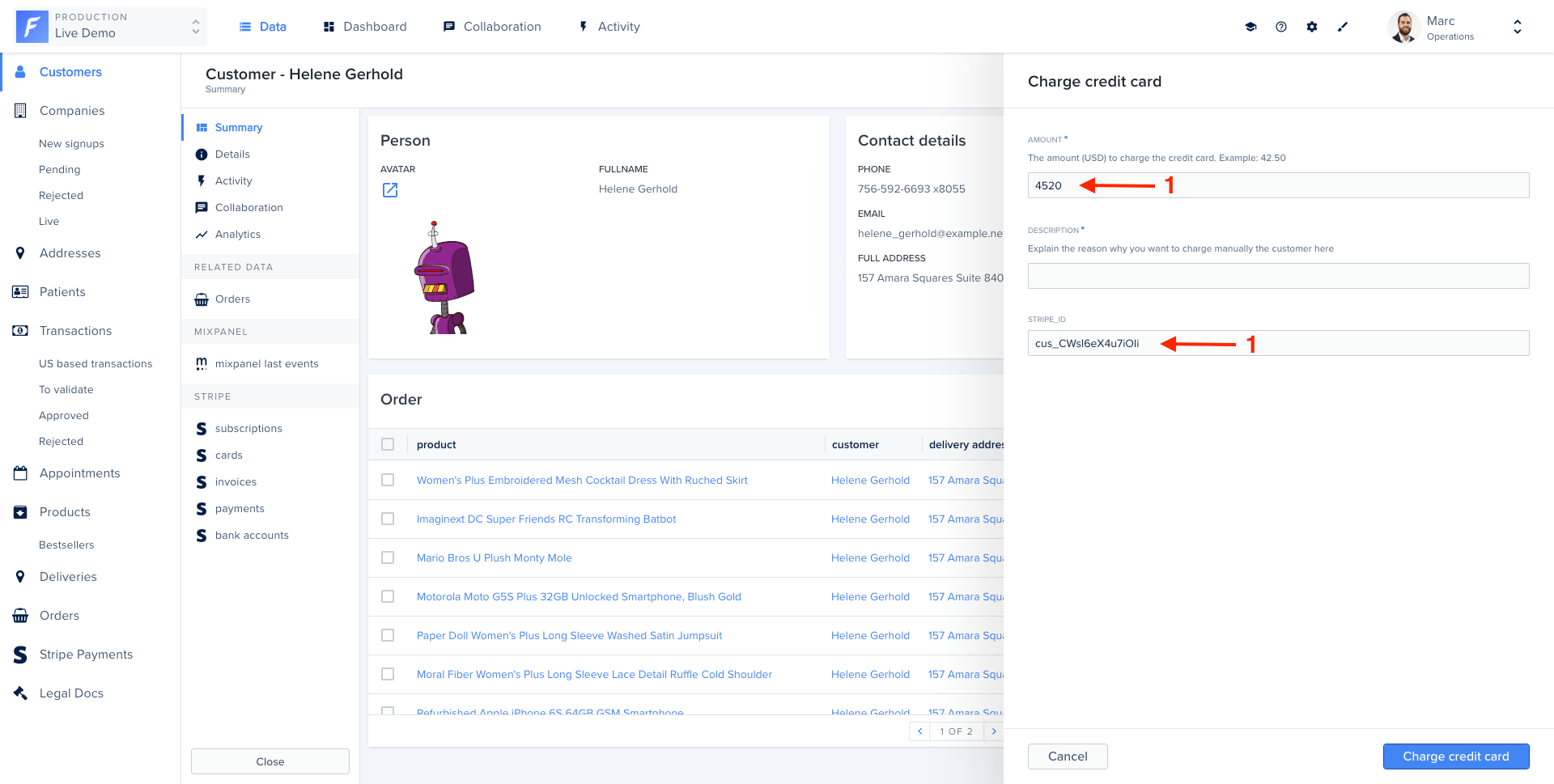
Forest allows you to set default values of your form. In this example, we will prefill the form with data coming from the record itself **(1)**, with just a few extra lines of code.
```javascript theme={null}
const { collection } = require('forest-express-sequelize');
const { customers } = require('../models');
collection('Customers', {
actions: [{
name: 'Charge credit card',
type: 'single',
fields: [{
field: 'amount',
isRequired: true,
description: 'The amount (USD) to charge the credit card. Example: 42.50',
type: 'Number'
}, {
field: 'description',
isRequired: true,
description: 'Explain the reason why you want to charge manually the customer here',
type: 'String'
}, {
// we added a field to show the full potential of prefilled values in this example
field: 'stripe_id',
isRequired: true,
type: 'String'
}],
hooks: {
load: async ({ fields, request }) => {
const amount = fields.find(field => field.field === 'amount');
const stripeId = fields.find(field => field.field === 'stripe_id');
amount.value = 4520;
const id = request.body.data.attributes.ids[0];
const customer = await customers.findByPk(id);
stripeId.value = customer.stripe_id;
return fields;
},
},
}],
...
});
```
```javascript theme={null}
const { collection } = require('forest-express-mongoose');
const { customers } = require('../models');
collection('Customers', {
actions: [{
name: 'Charge credit card',
type: 'single',
fields: [{
field: 'amount',
isRequired: true,
description: 'The amount (USD) to charge the credit card. Example: 42.50',
type: 'Number'
}, {
field: 'description',
isRequired: true,
description: 'Explain the reason why you want to charge manually the customer here',
type: 'String'
}, {
// we added a field to show the full potential of prefilled values in this example
field: 'stripe_id',
isRequired: true,
type: 'String'
}],
hooks: {
load: async ({ fields, request }) => {
const amount = fields.find(field => field.field === 'amount');
const stripeId = fields.find(field => field.field === 'stripe_id');
amount.value = 4520;
const id = request.body.data.attributes.ids[0];
const customer = await customers.findByPk(id);
stripeId.value = customer.stripe_id;
return fields;
},
},
}],
...
});
```
```ruby theme={null}
class Forest::Customers
include ForestLiana::Collection
collection :Customers
action 'Charge credit card',
type: 'single',
fields: [{
field: 'amount',
isRequired: true,
description: 'The amount (USD) to charge the credit card. Example: 42.50',
type: 'Number'
}, {
field: 'description',
isRequired: true,
description: 'Explain the reason why you want to charge manually the customer here',
type: 'String'
}, {
# we added a field to show the full potential of prefilled values in this example
field: 'stripe_id',
isRequired: true,
type: 'String'
}],
:hooks => {
:load => -> (context) {
amount = context[:fields].find{|field| field[:field] == 'amount'}
stripeId = context[:fields].find{|field| field[:field] == 'stripe_id'}
amount[:value] = 4520;
id = context[:params][:data][:attributes][:ids][0];
customer = Customers.find(id);
stripeId[:value] = customer['stripe_id'];
return context[:fields];
}
}
...
end
```
 ### Making a field read-only
To make a field read only, you can use the `isReadOnly` property:
| Name | Type | Description |
| ------------ | ------- | ---------------------------------------------------------------------------------------------- |
| `isReadOnly` | boolean | (optional) If `true`, the Smart action field won’t be editable in the form. Default is `false` |
Combined with the **load** [hook](/legacy/javascript-agents/reference-guide/actions/create-and-manage-smart-actions/overview#making-a-form-dynamic) feature, this can be used to make a field read-only dynamically:
```javascript theme={null}
const { customers } = require('../models');
collection('customers', {
actions: [
{
name: 'Some action',
type: 'single',
fields: [
{
field: 'country',
type: 'String',
isReadOnly: true,
},
{
field: 'city',
type: 'String',
},
],
hooks: {
load: async ({ fields, request }) => {
const country = fields.find((field) => field.field === 'country');
country.value = 'France';
const id = request.body.data.attributes.ids[0];
const customer = await customers.findById(id);
// If customer country is not France, empty field and make it editable
if (customer.country !== 'France') {
country.value = '';
country.isReadOnly = false;
}
return fields;
},
},
},
],
fields: [],
segments: [],
});
```
### Change your form's data based on previous field values
This feature is only available from **version 8.0.0** (`forest-express-sequelize` and `forest-express-mongoose`) / **version 7.0.0** (`forest-rails`) .
Here's a typical example: Selecting a **City** within a list of cities from the **Country** you just selected. Then selecting a **Zip code** within a list of zip codes located in the **City** you just selected.
```javascript theme={null}
const { getEnumsFromDatabaseForThisRecord } = require('./my-own-helper');
const { getZipCodeFromCity } = require('...');
const { collection } = require('forest-express-sequelize');
const { customers } = require('../models');
collection('customers', {
actions: [
{
name: 'Send invoice',
type: 'single',
fields: [
{
field: 'country',
type: 'Enum',
enums: [],
},
{
field: 'city',
type: 'String',
hook: 'onCityChange',
},
{
field: 'zip code',
type: 'String',
hook: 'onZipCodeChange',
},
],
hooks: {
load: async ({ fields, request }) => {
const country = fields.find((field) => field.field === 'country');
const id = request.body.data.attributes.ids[0];
const customer = await customers.findByPk(id);
country.enums = getEnumsFromDatabaseForThisRecord(customer);
return fields;
},
change: {
onCityChange: async ({ fields, request, changedField }) => {
const zipCode = fields.find((field) => field.field === 'zip code');
const id = request.body.data.attributes.ids[0];
const customer = await customers.findByPk(id);
zipCode.value = getZipCodeFromCity(customer, changedField.value);
return fields;
},
onZipCodeChange: async ({ fields, request, changedField }) => {
const city = fields.find((field) => field.field === 'city');
const id = request.body.data.attributes.ids[0];
const customer = await customers.findByPk(id);
city.value = getCityFromZipCode(customer, changedField.value);
return fields;
},
},
},
},
],
fields: [],
segments: [],
});
```
```javascript theme={null}
const { getEnumsFromDatabaseForThisRecord } = require('./my-own-helper');
const { getZipCodeFromCity } = require('...');
const { collection } = require('forest-express-mongoose');
const { customers } = require('../models');
collection('customers', {
actions: [
{
name: 'Send invoice',
type: 'single',
fields: [
{
field: 'country',
type: 'Enum',
enums: [],
},
{
field: 'city',
type: 'String',
hook: 'onCityChange',
},
{
field: 'zip code',
type: 'String',
hook: 'onZipCodeChange',
},
],
hooks: {
load: async ({ fields, request }) => {
const country = fields.find((field) => field.field === 'country');
const id = request.body.data.attributes.ids[0];
const customer = await customers.findById(id);
country.enums = getEnumsFromDatabaseForThisRecord(customer);
return fields;
},
change: {
onCityChange: async ({ fields, request, changedField }) => {
const zipCode = fields.find((field) => field.field === 'zip code');
const id = request.body.data.attributes.ids[0];
const customer = await customers.findById(id);
zipCode.value = getZipCodeFromCity(customer, changedField.value);
return fields;
},
onZipCodeChange: async ({ fields, request, changedField }) => {
const city = fields.find((field) => field.field === 'city');
const id = request.body.data.attributes.ids[0];
const customer = await customers.findById(id);
city.value = getCityFromZipCode(customer, changedField.value);
return fields;
},
},
},
},
],
fields: [],
segments: [],
});
```
```javascript theme={null}
actions 'Send invoice',
type: 'single',
fields: [
{
field: 'country',
type: 'Enum',
enums: []
},
{
field: 'city',
type: 'String',
hook: 'oncityChange'
},
{
field: 'zip code',
type: 'String',
hook: 'onZipCodeChange'
},
],
hooks: {
:load => -> (context){
country = context[:fields].find{|field| field[:field] == 'country'}
id = context[:params][:data][:attributes][:ids][0];
customer = Customers.find(id);
country[:enums] = getEnumsFromDatabaseForThisRecord(customer)
return context[:fields]
},
:change => {
'oncityChange'=> -> (context){
zipCode = context[:fields].find{|field| field[:field] == 'zip code'}
id = context[:params][:data][:attributes][:ids][0];
customer = Customers.find(id);
zipCode[:value] = getZipCodeFromCity(
context[:record],
context[:context][:changed_field][:value]
)
return context[:fields]
},
'onZipCodeChange'=> -> (context) {
city = context[:fields].find{|field| field[:field] == 'city'}
id = context[:params][:data][:attributes][:ids][0];
customer = Customers.find(id);
city[:value] = getCityFromZipCode(
context[:record],
context[:context][:changed_field][:value]
)
return context[:fields]
},
},
}
```
#### How does it work?
The `hooks` property receives a *context* object containing:
* the `fields` array in its current state (containing also the current values)
* the `request` object containing all the information related to the records selection. Explained [here](/legacy/javascript-agents/reference-guide/actions/create-and-manage-smart-actions/overview#available-smart-action-properties).
* the `changedField` is the current field who trigger the hook (only for change hook)
`fields` **must** be returned. Note that `fields` is an array containing existing fields with properties described in [this section](/legacy/javascript-agents/reference-guide/actions/create-and-manage-smart-actions/overview#handling-input-values).
If you want to use a widget inside of a hook, you'll need to use the following syntax on your field:
* For a `text area`, use `{ widgetEdit: 'text area editor', parameters: {} }`
* For a `boolean`, use `{ widgetEdit: 'boolean editor', parameters: {} }`
* For a `date` or a `dateonly`, use `{ widgetEdit: 'date editor', parameters: {} }`
* For a `file`, use `{ widgetEdit: 'file picker', parameters: {} }`
To dynamically change a property within a `load` or `change` [hook](/legacy/javascript-agents/reference-guide/actions/create-and-manage-smart-actions/use-a-smart-action-form#making-a-form-dynamic-with-hooks), just set it! For instance, setting a new *description* for the field `city`:
```javascript theme={null}
const city = fields.find((field) => field.field === 'city');
city.description = 'Please enter the name of your favorite city';
```
```javascript theme={null}
const city = fields.find((field) => field.field === 'city');
city.description = 'Please enter the name of your favorite city';
```
```javascript theme={null}
city = context[:fields].find{|field| field[:field] == 'city'}
city[:description] = "Please enter the name of your favorite city"
```
```python theme={null}
'hooks': {
'load': self.send_invoice_load,
}
...
def send_invoice_load(fields, request, *args, **kwargs):
country = next((x for x in fields if x['field'] == 'country'), None)
country['value'] = 'France'
return fields
```
### Add/remove fields dynamically
This feature is only available from [**version 8.0.0**](/legacy/javascript-agents/how-tos/maintain/upgrade-notes-sql-mongodb/upgrade-to-v8) (`forest-express-sequelize` and `forest-express-mongoose`) / [**version 7.0.0**](/legacy/javascript-agents/how-tos/maintain/upgrade-notes-sql-mongodb/upgrade-to-v7) (`forest-rails`).
You can add a `field` dynamically inside the `fields` array, like so:
```javascript theme={null}
[...]
hooks: {
change: {
onFieldChanged: ({ fields, request, changedField }) => {
[...]
fields.push({
field: 'another field',
type: 'Boolean',
});
return fields;
}
}
}
[...]
```
```javascript theme={null}
[...]
hooks: {
change: {
onFieldChanged: ({ fields, request, changedField }) => {
[...]
fields.push({
field: 'another field',
type: 'Boolean',
});
return fields;
}
}
}
[...]
```
```ruby theme={null}
:hooks => {
:change => {
'onFieldChanged' => -> (context) {
[...]
context[:fields].push({
field: 'another field',
type: 'Boolean',
});
return context[:fields];
}
}
}
```
```python theme={null}
'hooks': {
'change': {
'onFieldChanged': self.on_field_change,
'onAnotherFieldChanged': self.on_another_field_change,
}
}
...
def on_field_change(self, fields, request, changed_field, *args, **kwargs):
fields.append({
'field': 'another field',
'type': 'Boolean',
'hook': 'onAnotherFieldChanged',
})
return fields
def on_another_field_change(self, fields, request, changed_field, *args, **kwargs):
// Do what you want
return fields
```
### Get selected records with bulk action
When using hooks with a bulk Smart action, you'll probably need te get the values or ids of the selected records. See below how this can be achieved.
```javascript theme={null}
const { collection, RecordsGetter } = require('forest-express-sequelize');
const { customers } = require('../models');
const customersHaveSameCountry = require('../services/customers-have-same-country');
collection('customers', {
actions: [
{
name: 'Some action',
type: 'bulk',
fields: [
{
field: 'country',
type: 'String',
isReadOnly: true,
},
{
field: 'city',
type: 'String',
},
],
hooks: {
load: async ({ fields, request }) => {
const country = fields.find((field) => field.field === 'country');
const ids = await new RecordsGetter(
customers,
request.user,
request.query
).getIdsFromRequest(request);
const customers = await customers.findAll({ where: { id } });
country.value = '';
country.isReadOnly = false;
// If customers have the same country, set field to this country and make it not editable
if (customersHaveSameCountry(customers)) {
country.value = customers.country;
country.isReadOnly = true;
}
return fields;
},
},
},
],
fields: [],
segments: [],
});
```
```javascript theme={null}
const { collection, RecordsGetter } = require('forest-express-mongoose');
const { customers } = require('../models');
const customersHaveSameCountry = require('../services/customers-have-same-country');
collection('customers', {
actions: [
{
name: 'Some action',
type: 'bulk',
fields: [
{
field: 'country',
type: 'String',
isReadOnly: true,
},
{
field: 'city',
type: 'String',
},
],
hooks: {
load: async ({ fields, request }) => {
const country = fields.find((field) => field.field === 'country');
const ids = await new RecordsGetter(
customers,
request.user,
request.query
).getIdsFromRequest(request);
const customers = await customers.findAll({ _id: { $in: ids } });
country.value = '';
country.isReadOnly = false;
// If customers have the same country, set field to this country and make it not editable
if (customersHaveSameCountry(customers)) {
country.value = customers.country;
country.isReadOnly = true;
}
return fields;
},
},
},
],
fields: [],
segments: [],
});
```
```ruby theme={null}
class Forest::Customers
include ForestLiana::Collection
collection :Customers
action 'Some action',
type: 'bulk',
fields: [
{
field: 'country',
type: 'String',
is_read_only: true
},
{
field: 'city',
type: 'String'
},
],
:hooks => {
:load => -> (context) {
country = context[:fields].find{|field| field[:field] == 'country'}
ids = ForestLiana::ResourcesGetter.get_ids_from_request(context[:params], context[:user]);
customers = Customers.find(ids);
country[:value] = '';
country[:is_read_only] = false;
# If customers have the same country, set field to this country and make it not editable
if customers_have_same_country(customers)
country[:value] = customers.country;
country[:is_read_only] = true;
end
return context[:fields];
},
},
end
```
### Making a field read-only
To make a field read only, you can use the `isReadOnly` property:
| Name | Type | Description |
| ------------ | ------- | ---------------------------------------------------------------------------------------------- |
| `isReadOnly` | boolean | (optional) If `true`, the Smart action field won’t be editable in the form. Default is `false` |
Combined with the **load** [hook](/legacy/javascript-agents/reference-guide/actions/create-and-manage-smart-actions/overview#making-a-form-dynamic) feature, this can be used to make a field read-only dynamically:
```javascript theme={null}
const { customers } = require('../models');
collection('customers', {
actions: [
{
name: 'Some action',
type: 'single',
fields: [
{
field: 'country',
type: 'String',
isReadOnly: true,
},
{
field: 'city',
type: 'String',
},
],
hooks: {
load: async ({ fields, request }) => {
const country = fields.find((field) => field.field === 'country');
country.value = 'France';
const id = request.body.data.attributes.ids[0];
const customer = await customers.findById(id);
// If customer country is not France, empty field and make it editable
if (customer.country !== 'France') {
country.value = '';
country.isReadOnly = false;
}
return fields;
},
},
},
],
fields: [],
segments: [],
});
```
### Change your form's data based on previous field values
This feature is only available from **version 8.0.0** (`forest-express-sequelize` and `forest-express-mongoose`) / **version 7.0.0** (`forest-rails`) .
Here's a typical example: Selecting a **City** within a list of cities from the **Country** you just selected. Then selecting a **Zip code** within a list of zip codes located in the **City** you just selected.
```javascript theme={null}
const { getEnumsFromDatabaseForThisRecord } = require('./my-own-helper');
const { getZipCodeFromCity } = require('...');
const { collection } = require('forest-express-sequelize');
const { customers } = require('../models');
collection('customers', {
actions: [
{
name: 'Send invoice',
type: 'single',
fields: [
{
field: 'country',
type: 'Enum',
enums: [],
},
{
field: 'city',
type: 'String',
hook: 'onCityChange',
},
{
field: 'zip code',
type: 'String',
hook: 'onZipCodeChange',
},
],
hooks: {
load: async ({ fields, request }) => {
const country = fields.find((field) => field.field === 'country');
const id = request.body.data.attributes.ids[0];
const customer = await customers.findByPk(id);
country.enums = getEnumsFromDatabaseForThisRecord(customer);
return fields;
},
change: {
onCityChange: async ({ fields, request, changedField }) => {
const zipCode = fields.find((field) => field.field === 'zip code');
const id = request.body.data.attributes.ids[0];
const customer = await customers.findByPk(id);
zipCode.value = getZipCodeFromCity(customer, changedField.value);
return fields;
},
onZipCodeChange: async ({ fields, request, changedField }) => {
const city = fields.find((field) => field.field === 'city');
const id = request.body.data.attributes.ids[0];
const customer = await customers.findByPk(id);
city.value = getCityFromZipCode(customer, changedField.value);
return fields;
},
},
},
},
],
fields: [],
segments: [],
});
```
```javascript theme={null}
const { getEnumsFromDatabaseForThisRecord } = require('./my-own-helper');
const { getZipCodeFromCity } = require('...');
const { collection } = require('forest-express-mongoose');
const { customers } = require('../models');
collection('customers', {
actions: [
{
name: 'Send invoice',
type: 'single',
fields: [
{
field: 'country',
type: 'Enum',
enums: [],
},
{
field: 'city',
type: 'String',
hook: 'onCityChange',
},
{
field: 'zip code',
type: 'String',
hook: 'onZipCodeChange',
},
],
hooks: {
load: async ({ fields, request }) => {
const country = fields.find((field) => field.field === 'country');
const id = request.body.data.attributes.ids[0];
const customer = await customers.findById(id);
country.enums = getEnumsFromDatabaseForThisRecord(customer);
return fields;
},
change: {
onCityChange: async ({ fields, request, changedField }) => {
const zipCode = fields.find((field) => field.field === 'zip code');
const id = request.body.data.attributes.ids[0];
const customer = await customers.findById(id);
zipCode.value = getZipCodeFromCity(customer, changedField.value);
return fields;
},
onZipCodeChange: async ({ fields, request, changedField }) => {
const city = fields.find((field) => field.field === 'city');
const id = request.body.data.attributes.ids[0];
const customer = await customers.findById(id);
city.value = getCityFromZipCode(customer, changedField.value);
return fields;
},
},
},
},
],
fields: [],
segments: [],
});
```
```javascript theme={null}
actions 'Send invoice',
type: 'single',
fields: [
{
field: 'country',
type: 'Enum',
enums: []
},
{
field: 'city',
type: 'String',
hook: 'oncityChange'
},
{
field: 'zip code',
type: 'String',
hook: 'onZipCodeChange'
},
],
hooks: {
:load => -> (context){
country = context[:fields].find{|field| field[:field] == 'country'}
id = context[:params][:data][:attributes][:ids][0];
customer = Customers.find(id);
country[:enums] = getEnumsFromDatabaseForThisRecord(customer)
return context[:fields]
},
:change => {
'oncityChange'=> -> (context){
zipCode = context[:fields].find{|field| field[:field] == 'zip code'}
id = context[:params][:data][:attributes][:ids][0];
customer = Customers.find(id);
zipCode[:value] = getZipCodeFromCity(
context[:record],
context[:context][:changed_field][:value]
)
return context[:fields]
},
'onZipCodeChange'=> -> (context) {
city = context[:fields].find{|field| field[:field] == 'city'}
id = context[:params][:data][:attributes][:ids][0];
customer = Customers.find(id);
city[:value] = getCityFromZipCode(
context[:record],
context[:context][:changed_field][:value]
)
return context[:fields]
},
},
}
```
#### How does it work?
The `hooks` property receives a *context* object containing:
* the `fields` array in its current state (containing also the current values)
* the `request` object containing all the information related to the records selection. Explained [here](/legacy/javascript-agents/reference-guide/actions/create-and-manage-smart-actions/overview#available-smart-action-properties).
* the `changedField` is the current field who trigger the hook (only for change hook)
`fields` **must** be returned. Note that `fields` is an array containing existing fields with properties described in [this section](/legacy/javascript-agents/reference-guide/actions/create-and-manage-smart-actions/overview#handling-input-values).
If you want to use a widget inside of a hook, you'll need to use the following syntax on your field:
* For a `text area`, use `{ widgetEdit: 'text area editor', parameters: {} }`
* For a `boolean`, use `{ widgetEdit: 'boolean editor', parameters: {} }`
* For a `date` or a `dateonly`, use `{ widgetEdit: 'date editor', parameters: {} }`
* For a `file`, use `{ widgetEdit: 'file picker', parameters: {} }`
To dynamically change a property within a `load` or `change` [hook](/legacy/javascript-agents/reference-guide/actions/create-and-manage-smart-actions/use-a-smart-action-form#making-a-form-dynamic-with-hooks), just set it! For instance, setting a new *description* for the field `city`:
```javascript theme={null}
const city = fields.find((field) => field.field === 'city');
city.description = 'Please enter the name of your favorite city';
```
```javascript theme={null}
const city = fields.find((field) => field.field === 'city');
city.description = 'Please enter the name of your favorite city';
```
```javascript theme={null}
city = context[:fields].find{|field| field[:field] == 'city'}
city[:description] = "Please enter the name of your favorite city"
```
```python theme={null}
'hooks': {
'load': self.send_invoice_load,
}
...
def send_invoice_load(fields, request, *args, **kwargs):
country = next((x for x in fields if x['field'] == 'country'), None)
country['value'] = 'France'
return fields
```
### Add/remove fields dynamically
This feature is only available from [**version 8.0.0**](/legacy/javascript-agents/how-tos/maintain/upgrade-notes-sql-mongodb/upgrade-to-v8) (`forest-express-sequelize` and `forest-express-mongoose`) / [**version 7.0.0**](/legacy/javascript-agents/how-tos/maintain/upgrade-notes-sql-mongodb/upgrade-to-v7) (`forest-rails`).
You can add a `field` dynamically inside the `fields` array, like so:
```javascript theme={null}
[...]
hooks: {
change: {
onFieldChanged: ({ fields, request, changedField }) => {
[...]
fields.push({
field: 'another field',
type: 'Boolean',
});
return fields;
}
}
}
[...]
```
```javascript theme={null}
[...]
hooks: {
change: {
onFieldChanged: ({ fields, request, changedField }) => {
[...]
fields.push({
field: 'another field',
type: 'Boolean',
});
return fields;
}
}
}
[...]
```
```ruby theme={null}
:hooks => {
:change => {
'onFieldChanged' => -> (context) {
[...]
context[:fields].push({
field: 'another field',
type: 'Boolean',
});
return context[:fields];
}
}
}
```
```python theme={null}
'hooks': {
'change': {
'onFieldChanged': self.on_field_change,
'onAnotherFieldChanged': self.on_another_field_change,
}
}
...
def on_field_change(self, fields, request, changed_field, *args, **kwargs):
fields.append({
'field': 'another field',
'type': 'Boolean',
'hook': 'onAnotherFieldChanged',
})
return fields
def on_another_field_change(self, fields, request, changed_field, *args, **kwargs):
// Do what you want
return fields
```
### Get selected records with bulk action
When using hooks with a bulk Smart action, you'll probably need te get the values or ids of the selected records. See below how this can be achieved.
```javascript theme={null}
const { collection, RecordsGetter } = require('forest-express-sequelize');
const { customers } = require('../models');
const customersHaveSameCountry = require('../services/customers-have-same-country');
collection('customers', {
actions: [
{
name: 'Some action',
type: 'bulk',
fields: [
{
field: 'country',
type: 'String',
isReadOnly: true,
},
{
field: 'city',
type: 'String',
},
],
hooks: {
load: async ({ fields, request }) => {
const country = fields.find((field) => field.field === 'country');
const ids = await new RecordsGetter(
customers,
request.user,
request.query
).getIdsFromRequest(request);
const customers = await customers.findAll({ where: { id } });
country.value = '';
country.isReadOnly = false;
// If customers have the same country, set field to this country and make it not editable
if (customersHaveSameCountry(customers)) {
country.value = customers.country;
country.isReadOnly = true;
}
return fields;
},
},
},
],
fields: [],
segments: [],
});
```
```javascript theme={null}
const { collection, RecordsGetter } = require('forest-express-mongoose');
const { customers } = require('../models');
const customersHaveSameCountry = require('../services/customers-have-same-country');
collection('customers', {
actions: [
{
name: 'Some action',
type: 'bulk',
fields: [
{
field: 'country',
type: 'String',
isReadOnly: true,
},
{
field: 'city',
type: 'String',
},
],
hooks: {
load: async ({ fields, request }) => {
const country = fields.find((field) => field.field === 'country');
const ids = await new RecordsGetter(
customers,
request.user,
request.query
).getIdsFromRequest(request);
const customers = await customers.findAll({ _id: { $in: ids } });
country.value = '';
country.isReadOnly = false;
// If customers have the same country, set field to this country and make it not editable
if (customersHaveSameCountry(customers)) {
country.value = customers.country;
country.isReadOnly = true;
}
return fields;
},
},
},
],
fields: [],
segments: [],
});
```
```ruby theme={null}
class Forest::Customers
include ForestLiana::Collection
collection :Customers
action 'Some action',
type: 'bulk',
fields: [
{
field: 'country',
type: 'String',
is_read_only: true
},
{
field: 'city',
type: 'String'
},
],
:hooks => {
:load => -> (context) {
country = context[:fields].find{|field| field[:field] == 'country'}
ids = ForestLiana::ResourcesGetter.get_ids_from_request(context[:params], context[:user]);
customers = Customers.find(ids);
country[:value] = '';
country[:is_read_only] = false;
# If customers have the same country, set field to this country and make it not editable
if customers_have_same_country(customers)
country[:value] = customers.country;
country[:is_read_only] = true;
end
return context[:fields];
},
},
end
```